
How to Build an Influencer Marketing Strategy From Scratch

Building an influencer marketing strategy from scratch means deciding six things before you contact a single creator: what business outcome you want, who you need to reach, which one platform you will commit to, what your creator roster looks like by tier, how you will pay and structure deals, and how you will measure whether it worked. Most brands skip straight to finding creators, which is why average returns sit around $5.78 for every dollar spent while the best programmes hit $18 to $20. The gap is almost never the creators. It is the strategy underneath them.

This guide walks the whole build, in order.
What this piece covers
The difference between having a strategy and just running campaigns
How to set an objective that actually changes what you do next
Why one platform beats a multi-channel spread, and how to pick it
Designing your creator roster by tier, with real numbers
Budget models, deal structures, and what to hold back for amplification
The four-layer measurement framework, plus your first 90 days
What is an influencer marketing strategy, and how is it different from running campaigns?
Most brands think they have a strategy when what they actually have is a habit of hiring creators.
A campaign is an event, a strategy is a system
A campaign has a start date, an end date, a creator list, and a report. A strategy is the set of decisions that makes every campaign after it better than the last one. It defines who you are targeting, which platform you own, which creator tiers do which job, what you pay for and why, and what evidence would make you spend more or stop. Without that layer, each campaign starts from zero. You rediscover the same lessons, renegotiate the same rates, and rebuild the same creator relationships every quarter. The compounding never begins, which is the single biggest reason influencer budgets underperform in India.
Why the strategy layer is where the money is
The return data makes this concrete. Brands average roughly $5.78 back for every dollar spent on influencer marketing, but top-performing programmes reach $18 to $20 per dollar. That is not a three-fold difference in creator quality. It is a difference in creator selection discipline, measurement, and optimisation, which are strategy functions, not execution ones. Meanwhile somewhere between 26% and 60% of marketers still name measuring ROI as their biggest obstacle. If you build the measurement layer at the start rather than bolting it on after the first campaign, you land in the top group by default.
What you need before you start
You need three things in place, and none of them involve creators. First, a business objective specific enough that it rules options out. Second, clarity on who you are actually trying to reach, at a level more useful than an age bracket. Third, a budget you can sustain for at least three to six months, because influencer marketing compounds and a single burst rarely proves anything. If you have those, the rest of this guide is a sequence. If you do not, get them first. Starting without them is how brands end up with a folder of pretty content and no idea whether it did anything.
How do you set an objective that actually shapes the strategy?
An objective is only useful if a different objective would have produced a different plan. Most brand objectives fail that test.
Pick one primary outcome, not four
"Awareness, engagement, conversions and community" is not an objective, it is a wish list, and it produces a strategy optimised for nothing. Choose one primary outcome and let the others be secondary effects. Awareness means you are buying reach and will accept weaker conversion tracking. Consideration means you are buying trust and will prioritise engagement depth over audience size. Conversion means you are buying commerce pull and need trackable codes and links from day one. Content generation means you mainly want a library of authentic assets and should optimise for volume and usage rights rather than reach. Each of these builds a genuinely different roster, budget, and report.
Define the audience past demographics
"Women, 25 to 34, metros" is not enough to pick a creator. What you need is behavioural: what problem does this person have, where do they currently look for answers, whose recommendations do they act on, and what would make them distrust a recommendation. In India this matters more than most markets because language, region, and cultural context shift buying behaviour sharply. A creator who converts in Mumbai may do nothing in Coimbatore. Getting this right is what makes creator selection obvious later, and our playbook on choosing the right influencer for your brand goes deeper on translating audience definition into a shortlist.
Write the number you are trying to move
Before anything else, write down the single number this programme exists to change, and its current value. Branded search volume, qualified leads per month, cost per acquisition, repeat purchase rate, or content assets produced per quarter. Then write what result at 90 days would make you increase the budget, and what result would make you stop. Doing this in writing, before you are emotionally invested in a creator list, is the most useful hour you will spend. It also gives you the language to defend the budget later, because you will be reporting in the same terms as your paid media, not in likes.
Which platform should you build on first?
The instinct is to be everywhere. The data says the opposite, and this is one of the clearest findings in 2026 benchmarking.
Concentration beats spread
Benchmark data shows most brands are not spreading influencer effort across a broad channel mix. They commit to one primary platform, build creative systems and a creator roster for it, and only add secondary channels once there is clear incremental gain. This matters because your competitors are not actually everywhere either, even if their output suggests it. Spreading a first-year budget across Instagram, YouTube, and regional platforms means you never build enough repetition on any one to learn what works. Pick one, get good, then expand. The discipline feels restrictive and it is the reason concentrated programmes outperform.
How to choose the one
Choose on where your buyer already researches your category, not where you personally spend time. Instagram Reels remains the default for most Indian consumer categories, especially beauty, fashion, food, and lifestyle, and it is where the bulk of brand-deal activity sits. YouTube costs more per asset but sells trust for considered purchases in tech, finance, education, and anything needing explanation, because the content ranks, lasts, and reaches people actively researching. TikTok-style short video leads on raw engagement rates globally. Regional and vernacular platforms unlock Tier 2 and Tier 3 audiences at lower cost with unusually high trust, which is increasingly where India's new buying power sits.
The format decision follows the platform
Once the platform is set, decide your default format and stick to it long enough to learn. Short-form video costs 25% to 50% more than static posts because of scripting, filming, and editing, but it carries reach and is the format most Indian audiences actually consume. Static and carousel work for education-heavy or high-detail products. Long-form video is the most expensive single deliverable and the strongest for considered purchases. Do not mix all three in your first quarter. Run one format consistently, gather enough data to see a pattern, then vary deliberately rather than experimenting with everything at once.
How do you design your creator roster?
This is the part most guides handwave. Here are actual numbers to build against.
The tier architecture that works
For most brands below enterprise budgets, the working structure is a core roster of 15 to 30 micro creators supplemented by a wider seeding network of 50 to 100 nano creators. Micro creators, at 10,000 to 100,000 followers, are the engine: they average around 3.86% engagement against roughly 1.21% for mega creators, which is over three times higher, at around 60% lower cost per post. Cost per engagement runs roughly $0.20 for micro against $0.33 for macro. This is why 73% of brands now favour smaller creators, and why long-tail micro programmes account for around 64% of total creator spend, with macro deals at 22% and ambassador retainers at 14%.
What each tier is actually for
Do not use tiers by prestige, use them by function. Nano creators are for seeding, hyperlocal reach, honest product reviews, and generating a high volume of authentic content cheaply. Micro creators are your conversion layer, delivering the best blended return for commerce. Macro and mega creators buy reach and cultural visibility, not conversion, so use them for launches and awareness moments rather than expecting them to drive sales. Celebrity and ambassador-level partnerships sit in a different category entirely, closer to long-term brand identity work, which is why they are usually handled alongside celebrity and brand ambassador strategy rather than inside a creator programme. Choosing between reach and resonance is the core call, and our breakdown of micro versus macro influencers and which actually converts covers that trade-off properly.
Always-on beats seasonal bursts
The structural choice that separates mature programmes from beginners is always-on versus campaign bursts. Brands running rosters of 20 to 50 micro and nano creators who post consistently over months produce a steady drumbeat of social proof that compounds, and this approach consistently outperforms seasonal mega-creator campaigns on both conversion rate and brand recall. Repeat creators also produce better content, need less briefing, and negotiate more favourably. Building that roster over time is exactly what structured creator and talent management is for, and it is the difference between a channel that improves each quarter and one that resets to zero.
How should you budget and structure deals?
Budget design determines what your strategy can actually do, so build it in parts rather than as one lump.
The three-part budget
Split the budget into creator fees, content usage rights, and paid amplification, and decide all three at the start. Brands that spend everything on fees discover later that they cannot legally reuse the content and have nothing left to amplify what worked. In India, a starter programme realistically needs ₹1.5 to ₹3 lakh a month to fund eight to fifteen activations built on nano and micro creators. A growth-stage programme runs ₹4 to ₹10 lakh a month across twenty to forty activations. Below roughly ₹1.5 lakh a month, discovery and management overhead consume most of the value. Full cost context sits in our guide to influencer marketing costs in India.
Deal structures that align incentives
Flat fees are simple but leave value on the table. The structure performing best in 2026 is hybrid: a base fee plus a commission in the 10% to 15% range, with tiered performance bonuses. This aligns the creator with your actual outcome rather than paying the same regardless of result, and good creators generally welcome it because it raises their ceiling. Negotiate the whole package together, scope, usage rights, exclusivity window, and timeline, rather than haggling only on the headline fee. Longer-term and multi-post agreements almost always lower the per-asset rate, because creators value predictable income over one-off maximums.
Reserve budget for amplification
This is the highest-return line in the plan and the one most first-time strategies omit. Creator content deployed as paid ads typically delivers two to three times higher engagement and a lower cost per acquisition than brand-made creative, because it keeps the authenticity of a real person while reaching far beyond that person's followers. The method is simple: let content run organically for a few days, identify the genuine top performers, then put media behind those specifically rather than spreading budget evenly. This is where creator work and performance marketing become one system, and treating them as separate line items is how brands leave most of the return unclaimed.
How do you measure it properly?
Measurement has to be built before launch. Retrofitting it is how programmes get cancelled by a CFO who was never given a real answer.
The four-layer framework
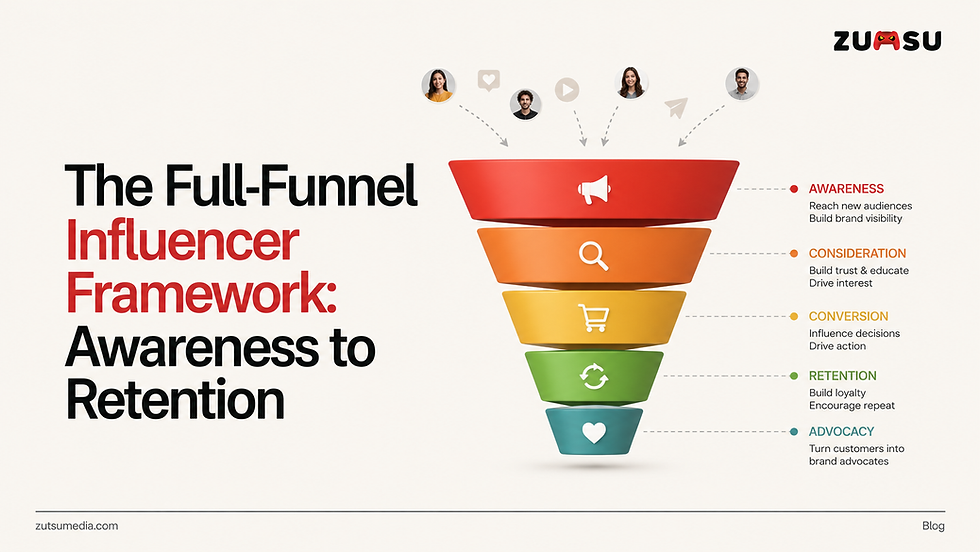
Use four layers, each matched to a part of the funnel. Awareness is measured through brand lift, tracking shifts in aided and unaided awareness among exposed audiences. Intent is measured through saves, shares, and comments, which indicate content with staying power rather than passive scrolling. Conversion is measured through promo codes and tagged URLs, the cleanest direct attribution available. Amplification is measured through the return on ad spend of creator content run as paid media, which converts top-of-funnel signal into hard, scalable evidence. Set one primary metric per objective with one to three supporting diagnostics, rather than tracking everything and understanding nothing.
Stop using last-click attribution
Last-click models systematically undervalue creators, because influencers usually start customer journeys rather than closing them. A creator who introduces someone to your brand gets no credit when that person converts through a branded search two weeks later, which makes the channel look weak and gets its budget cut. Use multi-touch attribution, or at minimum track branded search lift and direct traffic alongside coded conversions. Build the KPI framework in stages: start with conversion tracking, then layer in sentiment, customer lifetime value, and incrementality as the programme matures. This is the single change that most often turns an underperforming influencer budget into a defended one.
Review creators by return, not engagement
Set a recurring monthly session where you rank your creators by actual return rather than engagement rate, and act on it. Cut the bottom, expand the top, and note what the winners have in common, whether that is a niche, a format, an audience type, or a content style. That pattern becomes your selection criteria for the next cohort, which is how the programme compounds. Report to leadership in the same vocabulary used for paid media, cost per acquisition, return on ad spend, and incremental revenue, so influencer marketing is evaluated as a performance channel rather than as a branding experiment.
What operational and compliance foundations do you need?
Two practical layers hold the strategy up, and both are cheap to build early and expensive to retrofit.
Compliance is part of the strategy, not an afterthought
In India, ASCI requires clear disclosure of any material connection, appearing in the first two lines of a caption and verbally within the opening seconds of video, with repeated disclosure during live streams. Hiding disclosure in hashtag clusters or using #collab without #Ad is prohibited. This is backed by real financial risk, with the CCPA able to impose penalties up to ₹10 lakh on individuals and ₹50 lakh on entities for misleading advertisements. Build disclosure language into every brief, review content before it goes live, and keep records of approvals. It takes minutes per post and removes an entire category of risk from your programme.
Decide in-house, agency, or hybrid
Around 66% of brands now manage influencer marketing in-house, but the useful nuance is what to keep internal. Keep ownership of your KPIs, reporting standards, and definition of success, even if you outsource creator sourcing and campaign execution, because letting an external partner define success is how vanity reporting creeps in. For most brands past the starter stage, professional management pays for itself through better creator selection, tighter pricing, and stronger briefs, which is what a dedicated influencer marketing partner is built to deliver. The hybrid model, internal ownership with external execution, is where most successful Indian programmes land.
Build the asset library from day one
One underrated reason to run micro programmes is content volume. A micro-creator campaign costing roughly the same as a single agency photoshoot can produce 200 or more authentic assets usable across ads, email, product pages, and organic social. That only happens if you negotiated usage rights upfront and have somewhere organised to store and tag the content. Set up that library before your first campaign, not after, and treat every activation as producing two outputs: the creator's post, and a reusable asset for your own channels. It quietly doubles the value of the same spend.
What should your first 90 days look like?
Here is the sequence, compressed into a working plan.
Days 1 to 30: decide and prepare
Write the objective and the single number you are moving. Define the audience behaviourally. Choose one platform and one primary format. Set the three-part budget across fees, rights, and amplification. Draft the brief template including ASCI disclosure language and claim substantiation rules. Set up tracking, meaning UTM conventions, promo codes, and a baseline reading of your current branded search and conversion numbers. Do not contact creators yet. Everything in this month is preparation that makes the next sixty days work, and skipping it is the most common reason first programmes fail.
Days 31 to 60: pilot the roster
Onboard a first cohort, ideally eight to fifteen creators weighted heavily toward micro and nano, with a mix that lets you compare. Vet each on engagement quality, audience authenticity, and genuine brand fit rather than follower count. Brief them tightly on message and loosely on execution, because over-scripted content reliably underperforms. Stagger posting so you can observe rather than getting one indistinguishable spike. Watch for early winners in the first few days of each post, and begin amplifying the strongest content rather than waiting for the campaign to end.
Days 61 to 90: measure, cut, and double down
Run the full four-layer measurement against your baseline. Rank creators by actual return, not engagement. Cut the bottom third, offer repeat deals to the top performers at improved terms, and document what the winners had in common. Compare your result against the number you wrote in week one, and honour whatever decision you committed to, whether that is scaling up or stopping. Then plan the next quarter around the pattern you found rather than starting fresh. That loop, repeated four times, is what turns a first attempt into a programme that outperforms, and studying the biggest influencer campaigns in India that actually worked shows how consistently the winners came from sustained effort rather than single bursts.
Frequently asked questions
Q)How do you build an influencer marketing strategy from scratch?
A-Start by defining one primary business objective and the number you want to move, then define your audience behaviourally rather than demographically. Commit to a single platform and format, design a creator roster by tier, typically 15 to 30 micro creators plus a nano seeding network, split your budget across fees, usage rights, and paid amplification, and build measurement before launch. Only then begin contacting creators.
Q)How much budget do you need to start influencer marketing in India?
A-A starter programme realistically needs ₹1.5 to ₹3 lakh a month, funding eight to fifteen activations built mainly on nano and micro creators. Growth-stage programmes run ₹4 to ₹10 lakh a month across twenty to forty activations. Below roughly ₹1.5 lakh a month, discovery and management overhead consume most of the value, so a small budget is better spent on a tight handful of creators executed well.
Q)How many influencers should be in your roster?
A-For most brands below enterprise budgets, a core roster of 15 to 30 micro creators supported by a wider network of 50 to 100 nano creators works well. Always-on rosters of 20 to 50 creators posting consistently over months outperform seasonal campaigns with a few large names on both conversion and recall. Only about 15% of brands ever work with more than 1,000 creators, so scale is not the goal.
Q)Should you use one platform or several for influencer marketing?
A-Start with one. Benchmark data shows most brands commit to a single primary platform, build creative systems and a roster for it, and add secondary channels only when there is clear incremental gain. Concentration lets you build enough repetition to learn what works, whereas spreading a first-year budget across three platforms usually means learning nothing well on any of them.
Q)What is a good ROI for influencer marketing?
A-Brands average around $5.78 in return for every dollar spent, while top-performing programmes reach $18 to $20 per dollar. The gap comes mainly from creator selection discipline, measurement quality, and optimisation rather than from creator fame. Using multi-touch attribution instead of last-click is one of the most reliable ways to move from average to strong, since last-click systematically undervalues creators who start customer journeys.
Q)Should you manage influencer marketing in-house or through an agency?
A-Around 66% of brands now manage it in-house, but the strongest model is usually hybrid: keep ownership of KPIs, reporting standards, and the definition of success internally, while outsourcing creator sourcing, negotiation, and execution. This prevents vanity reporting while giving you access to established creator relationships, better rates, and stronger briefs.
The Bottom Line
An influencer marketing strategy is not a creator list. It is six decisions made before you contact anyone: the outcome you want, the audience you need, the one platform you will own, the roster architecture by tier, how you pay and what you retain rights to, and how you will prove it worked. Get those right and the creator selection becomes obvious, the budget becomes defensible, and each quarter builds on the last instead of restarting.
The brands earning $18 per dollar are not hiring better-known creators than the ones earning $5. They are running a system with measurement built in from day one, an always-on roster instead of seasonal bursts, and budget reserved to amplify what actually works.
If you want an influencer programme built as a system rather than a series of one-off campaigns, talk to Zutsu Media. You can also browse more of our thinking in the influencer marketing hub.
Zutsu Media is a 360 degree marketing and production agency headquartered in Mumbai, working with brands across India and the APAC region across 18 plus industries.

Comments