Full-Funnel Influencer Marketing: A Complete Framework (2026)

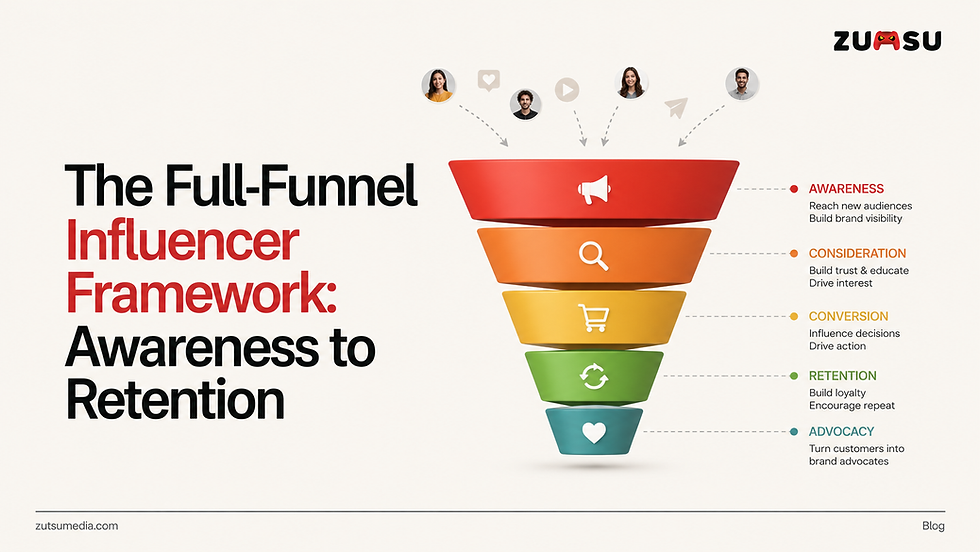
Full-funnel influencer marketing is the practice of using creators at every stage of the customer journey rather than only for awareness. Broad-reach creators drive top-of-funnel visibility, niche experts build middle-of-funnel consideration, community-intimate creators and affiliate mechanics close bottom-of-funnel conversion, and long-term partners plus customer content sustain advocacy. Each stage needs a different creator tier, content format, and success metric. Most brands run only the top and the bottom of the funnel, which is precisely why their creator programmes stall.
Key takeaways
Full-funnel influencer marketing assigns creators a stage-specific job instead of using one brief everywhere
Creator size falls as you move down the funnel while trust requirements rise
Nearly three quarters of brands now judge creator programmes on the same metrics as paid media
Roughly a third of brand-creator pairs run at least two campaigns together, making repeat cadence the industry benchmark
A realistic first campaign returns 2 to 3 times spend, rising to 4 to 6 times after about twelve months
What is full-funnel influencer marketing?
The term gets used loosely, so it is worth defining before building anything on it.
Full-funnel influencer marketing defined
Full-funnel influencer marketing means deploying creators across all four stages of the marketing funnel: awareness, consideration, conversion, and advocacy or loyalty. It contrasts with the traditional approach, in which influencers are treated purely as a top-of-funnel awareness channel and judged on reach. The defining characteristic is that each stage carries its own creator tier, content format, and success metric, so a creator hired to build reach is never measured against the same scorecard as one hired to close a sale.
Why one influencer brief cannot serve every funnel stage
The default pattern is to write one brief, send it to a group of creators, and expect it to do every job at once. It is the single most expensive habit in the channel and sits behind most of the common influencer marketing mistakes brands keep making. Content built for discovery has a different job from content built for evaluation, and both differ from content designed to remove the final friction before purchase. When brands recycle one brief across every creator, the output is adequate everywhere and decisive nowhere.
The influencer marketing funnel is no longer linear
One honest caveat before the framework. Buyers in 2026 do not move neatly from ToFu to BoFu. They jump stages, re-enter, research on AI tools, disappear for weeks, and return through a different channel. A rigid straight-line funnel is a planning tool, not a description of behaviour. The practical implication is to build for re-entry rather than sequence, meaning content at every stage should be live simultaneously rather than switched on in phases. Treat the four stages as four jobs that always need covering, not four steps a person walks through in order.
Why full-funnel influencer marketing outperforms single-stage campaigns
Most creator programmes are not underfunded. They are structurally incomplete.
What a stage-mapped creator strategy actually gives you
Adopting stage-specific roles changes three things immediately. Creator selection becomes obvious, because you are choosing for a job rather than for fame, which turns the playbook for choosing the right influencer into a filter rather than a guess. Measurement becomes defensible, because each stage carries its own metric rather than everything being judged on conversions. And budget allocation becomes deliberate, because you can finally see which stage is starved.
Creator programmes are now judged like paid media
Nearly three quarters of brands measure creator programmes against the same standards as paid media, using acquisition cost and average order value rather than engagement. That scrutiny is exactly why a stage-mapped framework has stopped being optional. A programme that reports only reach and likes will not survive a budget review in 2026, because the people approving the spend are comparing it directly against performance channels with clean attribution.
Not sure which funnel stage your creator programme is leaking? Zutsu Media maps influencer campaigns stage by stage for brands across 18 plus industries. Book a free funnel review.
Awareness stage: which influencers build top-of-funnel reach
The job at ToFu is not reach for its own sake. It is relevance and recall among the right people.
Best influencer tier for awareness campaigns
Awareness is where larger creators earn their fee. Macro and mid-tier creators, culturally relevant voices, and creators with genuine storytelling ability introduce your brand to audiences who have never encountered it. Choose for cultural relevance and narrative skill rather than raw follower count, and vet them properly before signing, since paying for reach that does not exist is the fastest way to waste a top-of-funnel budget. Our guide to spotting fake followers and bought engagement covers the ten-minute check. One planning caution that saves real money: audit audience overlap before booking, because five creators with near-identical audiences produce repetition rather than incremental reach.
Top-of-funnel influencer content formats that work
Awareness content has one job, which is making the right people care enough to remember you. That favours entertaining, culturally native formats such as short-form video, event-led content, and storytelling that carries the brand rather than explaining it. Completion rate matters more than likes at this stage, and platform differences are stark. Recent short-form data shows TikTok leading completion on sub-thirty-second videos at roughly 72%, Instagram Reels near 61%, and YouTube Shorts closer to 54%. Benchmark against the platform you actually use, or you will misjudge healthy performance as failure.
How to measure influencer brand awareness
Judge awareness on reach, impressions, video completion rate, and above all brand lift. Run pre and post-campaign awareness surveys among the target demographic, and track branded search volume as a practical proxy for whether the campaign moved anything. Monitor mention volume, sentiment, and share of voice against competitors. What you should not do is demand conversion numbers from awareness work, which is the fastest route to cancelling a campaign that performed normally. Establish the baseline before launch so the comparison means something.
Consideration stage: how influencers drive purchase intent
The middle of the funnel is where most programmes leak, and where influencer marketing is genuinely strongest.
Which influencers drive consideration best
MoFu belongs to niche experts and micro creators. Credibility and subject expertise matter more than reach here, because the audience is comparing options and looking for proof. A creator with deep category knowledge and a community that trusts their judgement will outperform a much larger generalist, and the economics work better too, which is covered in our comparison of micro versus macro influencers in India. For complex or trust-deficit categories, credible specialists are not a nice-to-have, they are the entire mechanism.
Influencer content that drives consideration
Consideration content is evaluative rather than aspirational: detailed reviews, tutorials, demonstrations, comparisons, and honest walk-throughs that help someone decide. It should answer the objections a buyer actually has rather than restating benefits. Long-form and mid-length formats earn their place here because the audience is willing to spend attention. This is also the stage where creative freedom matters most, since an over-scripted review is transparently promotional and destroys the exact credibility you are paying for. Give the message, not the words.
How to measure influencer-driven consideration
The right metrics here are intent signals rather than volume. Track saves, shares, and comment quality, since saves and shares indicate content with staying power and genuine lower-funnel intent rather than passive scrolling. Add profile visits, click-through rate, and time on site from creator traffic. Engagement benchmarks vary enormously by tier and platform, with TikTok nano creators reaching around 10.3% while Instagram nano creators average closer to 1.7%, so always compare against the correct platform and tier rather than a global figure.
Conversion stage: influencer marketing that drives sales
At BoFu, friction has to disappear and measurement becomes unambiguous.
Best creators for influencer conversion
Community intimacy wins at the bottom of the funnel. Nano and micro creators with close, high-trust relationships convert better than larger names, because a recommendation from someone who feels like a peer carries more weight than one from a distant celebrity. Around 32% of consumers report purchasing through an influencer's sponsored post in the past twelve months, with adoption notably higher among younger buyers. Choose creators with demonstrated commerce pull and a track record of driving action, not simply strong engagement on brand content.
Influencer content and mechanics that convert
The conversion stage runs on mechanics as much as creative: affiliate arrangements, promo codes, tracked links, and content built around removing the last objection. Formats should be direct, such as demonstrations, unboxings, limited offers, and social commerce integrations. The other essential lever is paid amplification. Allowlisting, also called whitelisting, means running top-performing organic creator content as paid media through the creator's own handle, which keeps the authenticity while reaching far beyond their followers and consistently outperforms brand-account creative. This is where creator work and performance marketing become one system rather than two budgets.
How to measure influencer conversion and ROAS
Promo codes and tagged URLs give the cleanest direct attribution available, so build them in before launch rather than retrofitting, following the UTM and promo code setup that keeps creator data clean. Track conversion rate, cost per acquisition, and return on ad spend, and compare influencer acquisition cost against your blended paid acquisition cost from other channels. A realistic first-campaign target is roughly 2 to 3 times return, with optimised programmes typically reaching 4 to 6 times after twelve months.
Want this built for your category? We run influencer marketing with attribution designed in from day one, not bolted on after the first campaign. Talk to our team.
Advocacy stage: turning influencer buyers into repeat customers
This is the stage almost every brand skips, and it is where the compounding lives.
Why always-on creator advocacy beats one-off campaigns
The most significant structural change in creator marketing is the move from one-off campaigns toward always-on advocacy systems combining loyalty mechanics with performance-driven creator work. Major brands have restructured affiliate and creator programmes into what are effectively loyalty layers, spreading budget across fifteen to thirty creators rather than concentrating on one or two expensive names. Nearly 80% of influencer collaborations now cost under $300, and user-generated content grew from around 15% of collaborations in 2024 to 35% in 2025, which tells you where the operating model is heading.
Post-purchase influencer content and UGC that retains customers
Advocacy content has a different job again: reassurance, community, and turning customers into voices. That means customer testimonials, user-generated content, community recommendations, how-to and getting-more-from-it content, and creator relationships that persist long enough for audiences to believe them. The organisational implication is real, since advocacy increasingly sits with performance and CRM teams rather than talent managers, because the skill required is designing one-to-many systems rather than negotiating individual deals. Sustaining those relationships is what structured creator and talent management exists to do.
The brand-creator repeat rate benchmark for 2026
Here is the most useful and least known number in this article. Analysis of roughly 87,793 brand-creator pairs found that almost a third run at least two deals together, making that the industry-wide repeat benchmark. The practical reading: if you have run three campaigns with a creator and have not closed a fourth, you are tracking below market, and if you have, you are in roughly the top 15%. Repeat cadence is also the strongest observable predictor of compounding return, which is a concrete argument for treating creator relationships as assets rather than transactions.
How to measure influencer retention and customer lifetime value
Retention metrics prove the channel's real advantage. Track customer lifetime value of influencer-acquired cohorts, repeat purchase rate, referral rate, and brand sentiment shift. The diagnostic question is simple: if customers acquired through creators churn at the same rate as those from paid ads, you are missing the point of trust-driven acquisition. Yet only around 20% of brands track acquisition cost in affiliate programmes and just 18% measure average order value, so simply doing this puts you ahead of most of the market.
The full-funnel influencer marketing framework in one table
Here is the whole model in a single planning view.
Funnel stage | Creator tier | Content format | Primary metric | Secondary signals |
Awareness (ToFu) | Macro, mid-tier, culture-led | Short-form video, storytelling, events | Brand lift and reach | Completion rate, branded search, share of voice |
Consideration (MoFu) | Niche experts, micro | Reviews, tutorials, comparisons | Saves and shares | CTR, profile visits, comment quality |
Conversion (BoFu) | Micro and nano, commerce-proven | Demos, offers, affiliate content | ROAS and CPA | Conversion rate, code redemptions |
Advocacy and loyalty | Long-term partners, customers | UGC, testimonials, community content | Cohort LTV | Repeat purchase rate, referral rate, sentiment |
How to read the influencer funnel stage table
Creator size falls as you move down the funnel while trust requirements rise. That inversion is the framework's central insight, and it explains why brands that spend most of their budget on large creators see strong reach and weak conversion. Notice also that the metric changes at every stage. Applying one scoreboard across all four is the most common measurement error in influencer marketing and the reason well-performing programmes get defunded.
The one brand metric, one performance metric rule
A practical discipline that prevents dashboard sprawl: for every campaign, assign exactly one brand metric and one performance metric. This stops teams optimising for awareness while ignoring conversion, or the reverse. Trying to track fifteen indicators from day one creates noise rather than insight. Start with one number per stage, prove the model works, then add nuance such as incrementality testing once the basics are stable and trusted.
How to build an influencer marketing measurement stack
Stage metrics only work if the underlying attribution is sound, and by default it is not.
Why last-click attribution breaks influencer measurement
The default model in most organisations is last-click, and it is structurally unfair to creator content. Influencers operate at the top and middle of the funnel, seeding intent before a buyer ever reaches a paid search ad, so a creator who started the journey receives no credit for a conversion landing two weeks later. Under this model the channel looks weak, budgets get cut, and brands conclude influencer marketing does not work when the measurement was simply pointed at the wrong moment. Multi-touch attribution, or at minimum branded search and direct traffic tracking alongside coded conversions, resolves most of this.
Building your influencer attribution layers in order
The workable approach is a layered stack matching the four stages: brand lift surveys at awareness, saves and shares at intent, promo codes and tagged links at conversion, and partnership ad return at amplification, which turns top-of-funnel signal into scalable evidence. Establish baselines before anything launches, including current branded search volume, direct traffic, and conversion rates, then run the numbers using a proper influencer marketing ROI formula. Earned media value has a supporting role for awareness, but it is a media equivalency estimate rather than revenue, so never let it lead the report.
ASCI disclosure compliance across every funnel stage
One foundation applies at every stage in India: disclosure. ASCI requires clear labelling of any material connection, appearing early in captions and verbally in video, backed by real financial exposure under consumer protection law. Paid creator content is advertising regardless of which funnel stage it serves, and treating BoFu affiliate content as organic opinion creates risk no performance gain justifies. Build disclosure language into every brief and review content before it goes live.
How to start a full-funnel influencer programme from scratch
The framework is not an all-at-once build. Sequence it.
Find the funnel stage where your influencer marketing leaks
Do not build all four stages simultaneously. Diagnose which stage is weakest and start there. If nobody knows you exist, start with awareness. If people know you but do not believe you, start with consideration, which is where most brands leak and where the fastest wins usually sit. If traffic arrives but does not convert, start with conversion mechanics. If customers buy once and vanish, advocacy is your priority. Fixing the weakest stage produces a bigger return than adding volume to a stage already working.
Build your influencer roster before the campaign
A working structure for most brands below enterprise budgets is a core group of fifteen to thirty micro creators supported by a wider nano seeding network, mirroring how brands now spread budget to test more content types. Recruit for stage-specific roles rather than one generic pool, and prioritise creators you can imagine working with repeatedly, since repeat cadence is the compounding mechanism. Realistic budget bands and what to pay each tier are covered in our breakdown of influencer marketing costs in India.
Run influencer marketing as an operating system
The framing that separates strong programmes from weak ones is treating creators as an operating system with defined platform roles, repeatable creative iteration, defensible measurement, and quality controls that scale with volume. Each campaign should produce performance data and audience insight that feeds the next brief, so the programme compounds rather than restarting. That loop, not any individual campaign, moves a brand from average returns toward the top of the benchmark range.
Planning festive or launch campaigns this quarter? Creator rates rise 20 to 40% in peak windows and good rosters lock early. Start the conversation now.
Full-funnel influencer marketing FAQs
What is full-funnel influencer marketing?
Full-funnel influencer marketing is the practice of using creators at every stage of the customer journey rather than only for awareness. Broad-reach creators drive top-of-funnel visibility, niche experts build consideration, community-intimate creators and affiliate mechanics drive conversion, and long-term partners plus customer content sustain advocacy. Each stage uses a different creator tier, content format, and success metric.
Which influencer tier works best for each funnel stage?
Awareness suits macro and mid-tier creators chosen for cultural relevance and storytelling. Consideration suits niche experts and micro creators whose category credibility carries weight. Conversion suits micro and nano creators with community intimacy and proven commerce pull. Advocacy suits long-term creator partners and actual customers producing user-generated content. Creator size generally falls as you move down the funnel while trust requirements rise.
How do you measure influencer marketing across the full funnel?
Use a layered stack: brand lift surveys and branded search for awareness, saves and shares for intent, promo codes and tagged URLs for conversion, and partnership ad return for amplification. Add cohort lifetime value and repeat purchase rate for advocacy. Establish baselines before launch and avoid last-click attribution, which systematically undervalues creators who start journeys they do not close.
What ROAS should a full-funnel influencer programme deliver?
A first campaign realistically targets 2 to 3 times return, with optimised programmes typically reaching 4 to 6 times after about twelve months. Industry averages sit near $5.20 to $5.78 per dollar spent. Compare influencer acquisition cost against blended paid acquisition cost from other channels, since that comparison is what finance teams actually evaluate.
Why do most brands skip the advocacy stage of influencer marketing?
Because advocacy requires ongoing relationships and CRM-style thinking rather than campaign management, and because most measurement stops at purchase. Only around 20% of brands track acquisition cost in affiliate programmes and 18% measure average order value. Yet advocacy is where influencer marketing's core advantage shows up, since trust-driven acquisition should produce higher lifetime value than paid-ad acquisition.
How many creators do you need for a full-funnel influencer programme?
Most brands below enterprise budgets work well with a core roster of fifteen to thirty micro creators plus a wider nano seeding network. What matters more than roster size is repeat cadence, since roughly a third of brand-creator pairs run at least two deals together and reaching a fourth places you in about the top 15%.
The bottom line on full-funnel influencer marketing
Full-funnel influencer marketing works because it stops asking one brief to do four different jobs. Larger creators for awareness, credible experts for consideration, community-intimate creators plus affiliate mechanics for conversion, and long-term partners plus customer content for advocacy. Creator size falls as you move down the funnel; trust requirements rise.
The two things most brands get wrong are running only ToFu and BoFu, and applying a single metric across all four stages. Fix those and the programme becomes defensible in a budget meeting, which is usually the difference between a channel that survives and one that gets cut.
Start where your funnel actually leaks rather than building all four stages at once, build a roster you intend to work with repeatedly, and run the whole thing as an operating system that learns from each cycle.
For a creator programme built stage by stage with measurement designed in from the start, talk to Zutsu Media. We run influencer marketing for brands across 18 plus industries, and more of our thinking sits in the influencer marketing hub.
About the author. This guide was produced by the Zutsu Media editorial team. Zutsu Media is a 360 degree marketing and production agency headquartered in Mumbai, managing 23 plus creators and running influencer, PR, and performance campaigns for brands across 18 plus industries in India and the APAC region.


Comments