
How to Calculate Influencer Marketing ROI (With a Working Formula)

The core formula is ROI = ((Revenue attributed − Total campaign cost) ÷ Total campaign cost) × 100, expressed as a percentage, while ROAS = Revenue ÷ Cost, expressed as a ratio. The formula is the easy part. The number it produces is only as honest as three inputs most brands get wrong: total cost, which routinely omits gifting, shipping, licensing, and management time and inflates ROI by 15 to 30%; the attribution window, since most influencer purchases happen 7 to 30 days after exposure rather than immediately; and incrementality, because some of those buyers would have purchased anyway. This guide works through all three with real numbers.

Key takeaways on influencer marketing ROI
The core formula is ROI = ((Revenue attributed − Total campaign cost) ÷ Total campaign cost) × 100
ROAS = Revenue ÷ Cost, expressed as a ratio, and is easier to compare against other channels
Counting only creator fees inflates reported ROI by roughly 15 to 30%
Most influencer purchases happen 7 to 30 days after exposure, so short attribution windows undercount
The same campaign can read as 300% ROI on revenue and 60% on gross margin, so state which you are reporting
Incrementality testing often halves an apparently strong return, and it is the honest number
What this influencer marketing ROI guide covers
The two formulas, ROI and ROAS, and when to use each
A full worked example in rupees, from cost build to final number
The three inputs that make most reported ROI figures wrong
How incrementality testing changes the answer, with the maths shown
Earned media value, what it is worth, and where it misleads
Current benchmarks so you know whether your number is any good
What are the actual formulas?
Two calculations, used for different conversations, and mixing them up causes most reporting confusion.
The ROI formula
Return on investment is expressed as a percentage and answers how much you gained relative to what you spent.
ROI = ((Revenue attributed − Total campaign cost) ÷ Total campaign cost) × 100
If a campaign costs ₹8,00,000, in line with the influencer marketing budget bands in India, and generates ₹32,00,000 in attributed revenue, the calculation is ((32,00,000 − 8,00,000) ÷ 8,00,000) × 100, which gives 300% ROI. The wording matters when you report it: 300% ROI means you got your money back plus three times that amount, not that revenue was three times spend. Being sloppy about this in a board deck is a fast way to lose credibility with a finance team that will check.
The ROAS formula
Return on ad spend is a ratio rather than a percentage and is the language most performance teams already use.
ROAS = Revenue attributed ÷ Total campaign cost
The same campaign gives 32,00,000 ÷ 8,00,000 = 4:1, meaning four rupees back for every rupee spent. ROAS is easier to compare across channels, which is why it is usually the better number to put next to your paid media reporting. Most mature brands track both: ROAS for channel comparison, ROI for the profitability conversation. Report them together and label them clearly rather than using the terms interchangeably.
The profit-based influencer ROI formula your CFO wants
Both formulas above use revenue, which overstates the business result because revenue is not profit. The more defensible version substitutes gross profit.
Profit-based ROI = ((Attributed revenue × Gross margin − Total cost) ÷ Total cost) × 100
Take the same campaign at a 40% gross margin. Gross profit is ₹12,80,000, so the calculation becomes ((12,80,000 − 8,00,000) ÷ 8,00,000) × 100, which gives 60% ROI. The identical campaign reads as 300% on revenue and 60% on margin. Neither is dishonest, but only one survives contact with a finance director. Decide which you are reporting and say so explicitly.
What belongs in the cost side?
This is where most reported ROI figures quietly break, and it is entirely fixable.
The costs brands routinely forget
Counting only creator fees inflates ROI by roughly 15 to 30%, which is one of the common influencer marketing mistakes brands keep making. A complete cost model includes creator fees, product gifting and the shipping to send it, content usage and licensing fees, agency or management time, platform and tool subscriptions, and any paid amplification budget behind the content. If your ROI is built on fees alone, you are making future budget decisions on flawed data, and the error compounds every planning cycle because you keep expecting a return the channel never actually delivered.
A worked cost build
Here is a realistic Indian campaign cost stack for ten micro creators.
Cost line | Amount |
Creator fees (10 × ₹40,000) | ₹4,00,000 |
Product gifting and shipping | ₹60,000 |
Content usage rights | ₹75,000 |
Management and agency time | ₹1,00,000 |
Paid amplification | ₹1,65,000 |
Total campaign cost | ₹8,00,000 |
Notice that creator fees are only half the total. A brand reporting on fees alone would have used ₹4,00,000 as the denominator and claimed 700% ROI on the same ₹32,00,000 revenue, versus the accurate 300%. That single accounting choice more than doubles the apparent result, which is exactly why so many influencer programmes look excellent on a slide and disappointing in the P&L.
Where paid amplification sits in influencer ROI
One judgement call worth making deliberately: whether paid amplification counts as influencer cost or paid media cost. Both are defensible, but be consistent. If you allowlist creator content and run it as paid, the cleanest approach is to include the media spend in the influencer cost when you are judging the creator programme as a whole, and to report the amplification separately when comparing against your other paid channels. What you must not do is exclude it from cost while including the revenue it generated, which is the most common way influencer ROI gets accidentally overstated.
How do you get the revenue side right?
Attribution is where the honest work happens, and defaults will mislead you.
Set up influencer tracking before launch, never after
Every creator needs a unique promo code and a unique UTM link, assigned before anything goes live, following the UTM and promo code setup that keeps creator data clean. Backfilling tracking after launch loses an estimated 30 to 50% of attributable conversions, because the early traffic is already gone and unrecoverable. This is the single highest-return hour of work in the entire campaign. It also lets you compare creators against each other afterwards, which is how the programme improves rather than repeating.
Choose an attribution window that matches buying behaviour
Most influencer-driven purchases happen 7 to 30 days after exposure rather than the same day, so a short window systematically undercounts. A 24-hour window misses the majority of conversions. Set at least 14 days as a floor, and 30 days for considered or higher-value purchases. Then state the window in your report, because a 7-day and a 30-day number are not comparable and quietly switching between them across campaigns makes your trend data meaningless.
Move off last-click attribution
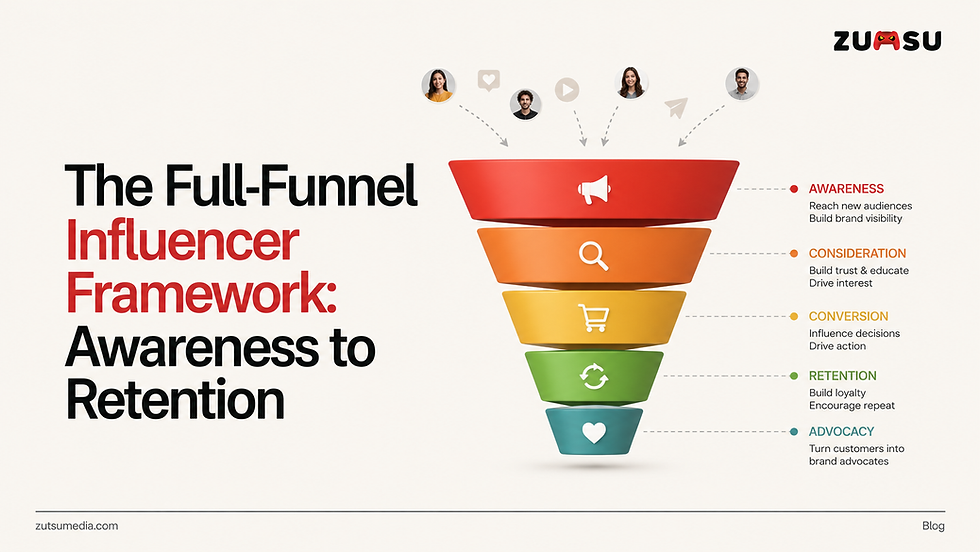
Last-click is the default in most organisations and it structurally undervalues creators, who typically start journeys they do not close. Around 73% of brands using multi-touch attribution report more accurate ROI than those relying on last-touch alone. A practical replacement is a U-shaped model that gives 40% credit to the first touch, 40% to the last, and spreads 20% across the middle. Where a full model is not feasible, tracking branded search lift and direct traffic alongside coded conversions captures much of what last-click hides. This is the same measurement problem that shapes the full-funnel influencer framework, where each stage needs its own metric.
Not sure your influencer numbers hold up? Zutsu Media builds creator programmes with cost accounting and attribution designed in from day one. Request an ROI review.
Incrementality testing: the true influencer marketing ROI
This is the section that separates a real ROI figure from a flattering one.
Why attributed revenue overstates influencer ROI
Some people who purchased after seeing creator content would have bought anyway through search, loyalty, or another channel. Attributed revenue includes them. Incremental revenue does not. Incrementality testing isolates the difference by comparing an exposed group against a holdout group who saw no influencer content, and it is the closest thing the discipline has to a gold standard because it measures causation rather than correlation.
Influencer incrementality maths, worked through
Suppose your exposed audience converts at 15% and your holdout converts at 10%. The lift is 5 percentage points, meaning one third of the conversions in the exposed group were genuinely caused by the campaign and two thirds would have happened regardless. Applied to our example, that turns ₹32,00,000 in attributed revenue into roughly ₹10,67,000 in incremental revenue. ROAS falls from 4:1 to about 1.3:1, and profit-based ROI goes from positive to negative. That is a sobering result, and it is also the truthful one.
When to run incrementality tests on influencer campaigns
Incrementality testing needs genuine scale to produce reliable results, so it is not appropriate for a campaign with ten creators and a modest budget. For smaller programmes, UTM links and promo codes are the honest floor: they undercount, but they do not invent. The practical rule is to match the method to your volume, use coded attribution while your programme is small, and introduce holdout testing once spend is large enough that the difference between attributed and incremental revenue is worth thousands of rupees rather than hundreds.
What about earned media value?
EMV is the most quoted and most misused number in influencer reporting.
How EMV is calculated
Earned media value estimates what you would have paid to buy equivalent reach through advertising.
EMV = (Impressions ÷ 1,000) × Platform CPM
If a campaign generated 25,00,000 impressions and the comparable CPM on that platform is ₹250, EMV works out to ₹6,25,000. Because CPMs differ sharply by platform and market, use platform-specific rates rather than a blended figure. Indian CPMs also sit well below US benchmarks, so importing an American CPM into an Indian EMV calculation inflates the result substantially.
Why EMV is not ROI
EMV is a media equivalency estimate, not money in the bank, and treating it as proof of business impact is the fastest way to lose a leadership team's trust. Influencer content generated an estimated $236 billion in EMV globally in 2026, which tells you how freely the metric gets quoted. It has genuine uses: benchmarking awareness campaigns, comparing creator efficiency, and contextualising exposure that direct attribution cannot capture. It has one disqualifying weakness, which is that nobody ever banked an impression.
How to report earned media value honestly
The workable approach is to layer rather than choose. Lead with revenue metrics, cost per acquisition, and ROAS, then present EMV as supporting context for the awareness portion of the campaign. The framing that builds trust is telling stakeholders here is what we can prove, and here is the estimated additional value, rather than opening with an inflated EMV total. Reports that lead with EMV and never mention acquisition cost are speaking a language most finance teams have stopped accepting.
What is a good influencer marketing ROI?
Context for whatever number your calculation produces.
Current benchmarks
Industry averages sit at roughly $5.20 to $5.78 returned per dollar spent, with top-performing programmes in high-conversion niches reaching $18 to $20 per dollar. A realistic first-campaign target is closer to 2 to 3 times return, rising to 4 to 6 times for optimised programmes after about twelve months. Encouragingly for cost efficiency, influencer CPMs dropped substantially year on year according to Aspire's recent reporting, which improves the input side of the calculation even before you optimise anything.
Judge influencer ROI over the right timeframe
Influencer marketing's measured strength is long-term payback rather than immediate return, with IPA data indicating long-term effects well above short-term figures. That means judging a campaign at week one produces a number that understates it, and cutting a programme on a fortnight of data is a common and expensive mistake. Expect modest early results and set the evaluation window to months rather than weeks. Guidance on setting the right expectations upfront sits in our piece on realistic goals for a first influencer campaign.
Segment influencer ROI by tier, platform and region
A single blended ROI figure hides everything useful. Break results down by creator tier, platform, content format, and region, and hold each against the influencer ROI benchmarks for your industry, because the pattern is where the next campaign's decisions come from. Evidence consistently indicates nano and micro creators outperform macro and celebrity tiers on return per rupee, a direction supported by academic analysis of large purchase datasets, though exact multiples vary widely enough that you should trust the pattern rather than any fixed number. Our comparison of micro versus macro influencers in India covers where each tier earns its place.
Want influencer spend judged like paid media? We report creator campaigns on acquisition cost and return, not impressions. Talk to our team.
Why brands still struggle to measure influencer marketing ROI
Worth naming, because the difficulty is real rather than a failure of effort.
The influencer measurement confidence gap is industry-wide
Around 79% of marketers cite measuring influencer ROI as their biggest obstacle, and only about 40% express complete confidence in the influencer data they report to leadership. That is a striking admission from a channel this mature. The causes are structural: multi-touch attribution is genuinely hard, platform data is limited, and there is no standardised EMV methodology across the industry. Knowing this should make you more rigorous rather than more discouraged, because a brand that measures honestly is already ahead of most of the market.
Privacy changes made attribution harder
Tracking has become materially harder as third-party cookies wound down and privacy regulation tightened. The practical response is a shift toward first-party data: capturing email addresses, account sign-ups, and loyalty programme membership, then matching those back to creator touchpoints. Promo codes have quietly become more valuable for exactly this reason, and vetting creators properly first, using the checks in our guide to spotting fake followers, keeps the revenue side honest too, since a code redemption is a first-party signal that survives cookie loss entirely.
Build the influencer ROI reporting habit, not just the calculation
The final point is procedural. Record a pre-campaign baseline covering branded search volume, direct traffic, and conversion rate, so post-campaign numbers mean something. Assign one primary metric per objective rather than tracking fifteen. Review monthly and rank creators by return rather than engagement. The formula takes a minute; the discipline around it is what produces a number you can defend, and connecting that measurement to your wider performance marketing reporting is what lets influencer spend be judged on the same terms as every other channel.
Influencer marketing ROI FAQs
What is the formula for influencer marketing ROI?
The standard formula is ROI = ((Revenue attributed − Total campaign cost) ÷ Total campaign cost) × 100, giving a percentage. ROAS = Revenue ÷ Cost, giving a ratio. For a more defensible figure, substitute gross profit for revenue, since revenue-based ROI overstates the business result. Always state which version you are reporting, because the same campaign can read as 300% on revenue and 60% on margin.
What costs should be included in influencer marketing ROI?
Include creator fees, product gifting and shipping, content usage and licensing fees, agency or management time, tool and platform subscriptions, and paid amplification. Counting only creator fees inflates ROI by roughly 15 to 30%, and in a typical campaign fees may be only half the true total cost. Incomplete cost accounting is the most common reason reported influencer ROI is wrong.
What attribution window should you use for influencer campaigns?
At least 14 days, and 30 days for considered or higher-value purchases, because most influencer-driven purchases happen 7 to 30 days after exposure rather than immediately. A 24-hour window misses the majority of conversions. State the window in every report, since 7-day and 30-day figures are not comparable and switching between them makes trend data unusable.
What is incrementality testing in influencer marketing?
It compares an exposed audience against a holdout group who saw no influencer content, isolating the conversions the campaign actually caused rather than simply correlated with. If exposed converts at 15% and holdout at 10%, only about a third of conversions were genuinely incremental. It is the most accurate method available but needs real scale, so smaller programmes should rely on promo codes and UTM links instead.
Is earned media value the same as ROI?
No. EMV estimates what equivalent reach would have cost through paid advertising, calculated as impressions divided by 1,000 multiplied by platform CPM. It is a media equivalency estimate rather than revenue, so it should support an awareness story, not substitute for one. Lead reporting with revenue, cost per acquisition, and ROAS, and present EMV as additional context.
What is a good ROI for influencer marketing?
Industry averages sit around $5.20 to $5.78 per dollar spent, with top programmes in high-conversion niches reaching $18 to $20. A realistic first campaign targets 2 to 3 times return, rising to 4 to 6 times for optimised programmes after roughly twelve months. Judge over months rather than weeks, since influencer marketing's measured strength is long-term payback.
The bottom line on calculating influencer marketing ROI
The formula is simple. Getting an honest number is not.
Build the full cost stack rather than counting creator fees, because omitting gifting, licensing, management, and amplification inflates your result by 15 to 30%. Set tracking before launch, since backfilling loses up to half your attributable conversions. Use an attribution window of at least 14 days and move off last-click. Report profit-based ROI alongside ROAS, and keep earned media value in a supporting role rather than leading with it.
Then, once your programme is large enough, run an incrementality test and accept whatever it tells you. A smaller number you can defend is worth considerably more than a large one that collapses the first time a finance director examines it.
For influencer programmes measured properly from the first campaign, with tracking, cost accounting, and reporting built in from the start, talk to Zutsu Media. We run influencer marketing for brands across 18 plus industries, and more of our thinking sits in the influencer marketing hub.
About the author. This guide was produced by the Zutsu Media editorial team. Zutsu Media is a 360 degree marketing and production agency headquartered in Mumbai, managing 23 plus creators and running influencer, PR, and performance campaigns for brands across 18 plus industries in India and the APAC region.

Comments